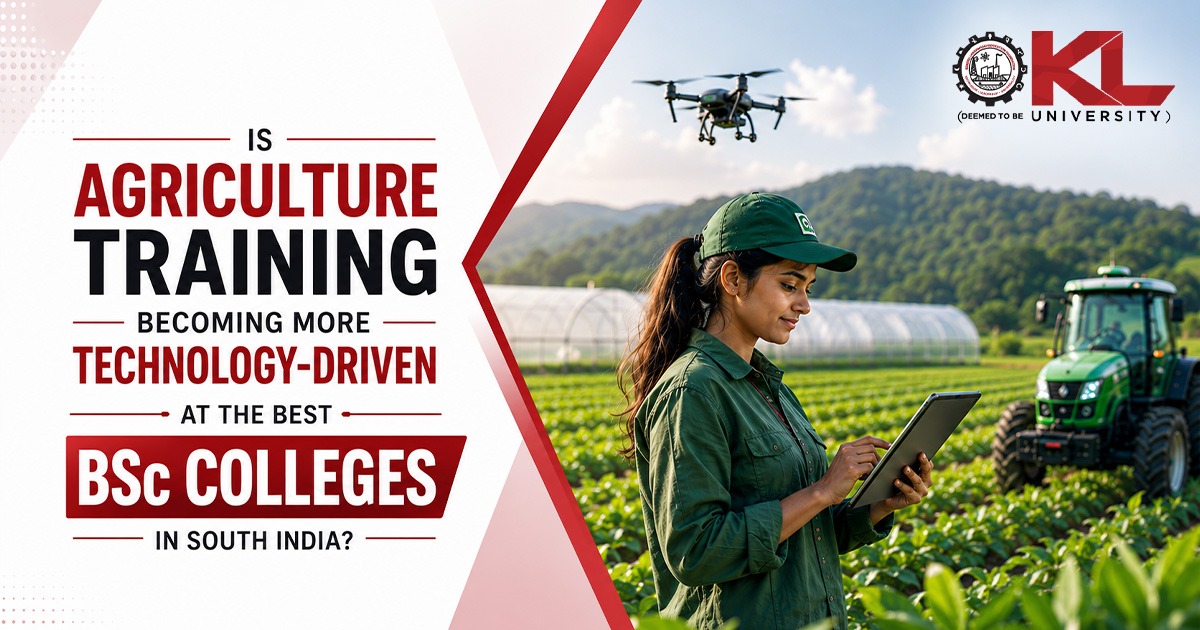
Agriculture is changing in ways that go well beyond better farming equipment. Weather data, satellite imagery, drones, sensors, biotechnology and digital tools are increasingly being used to understand crops, soil and farm conditions.
That raises a useful question for students considering Agriculture as a degree.
What will you actually learn about these technologies during your undergraduate programme at the best BSc colleges in South India?
Let’s explore the answer in this blog.
Why is technology becoming part of Agriculture?
Agriculture has always involved uncertainty.
A farmer has to deal with changing weather, soil conditions, pests, water availability, and crop diseases. Technology cannot eliminate all of these variables, but it can provide more information to make decisions.
For example, satellite imagery can help monitor large agricultural areas. Sensors can provide information about soil moisture. Weather data can support irrigation and crop planning.
India's Digital Agriculture Mission reflects this broader shift. The government has been building digital infrastructure around farmer, crop, and land information, while technology-enabled systems are being developed for areas such as crop monitoring and agricultural advisories.
This makes technology exposure increasingly relevant when students evaluate the best BSc colleges in South India.
What does technology actually change on a farm?
It is easy to think of agricultural technology as simply using a drone or an app. The more important change is what happens to decision-making.
Soil and water management
Consider irrigation.
Instead of watering an entire field in exactly the same way, information about soil moisture, crop requirements and weather conditions can help determine where and when water is needed.
The technology provides the information. Agricultural knowledge helps interpret it.
The best BSc colleges in South India teach you both.
Crop monitoring
A crop can show signs of stress before a farmer can easily identify the problem across a large field.
Drones, satellite imagery and sensors can help detect variations in crop conditions. These technologies can support monitoring for crop stress, disease and other changes.
But an image is only useful when someone understands what it could mean. Graduates from the best BSc colleges in South India do exactly that.
Weather and crop forecasting
Weather is one of the biggest variables in agriculture.
Temperature, rainfall, humidity and extreme weather can influence planting, irrigation, pest activity and harvesting.
Data-based forecasting can help farmers and agricultural professionals make better-informed decisions. Similarly, crop and yield forecasting can support planning across farms and agricultural supply chains.
Students at the best BSc colleges in South India can benefit from understanding how agricultural data is collected, interpreted and applied rather than treating technology as something separate from Agriculture.
Pest and disease management
Technology can also support earlier identification of crop problems.
Digital imaging, sensors and data-driven systems can help identify patterns associated with pests or diseases. This can support more targeted interventions rather than relying only on broad treatment.
Again, the agricultural scientists who are trained at the best BSc colleges in South India still matter, but technology makes the process easier.
So, what does a technology-driven Agriculture degree look like?
It doesn't mean replacing agricultural science with technology.
The foundation remains important.
Students still need to understand plant science, crop production, soil, plant pathology, genetics, agricultural biotechnology, statistics, agricultural economics, and farm management.
Technology then becomes another layer on top of that foundation.
That is what Agriculture education at the best BSc colleges in South India looks like.
What technologies should Agriculture students understand?
The exact exposure will vary by programme, but typically at the best BSc colleges in South India, you’ll see opportunities in:
- GIS and remote sensing for mapping and monitoring agricultural land
- Drones for crop observation and targeted agricultural applications
- Sensors for monitoring soil and environmental conditions
- Data analytics for interpreting agricultural information
- AI applications for prediction, monitoring and decision support
- Precision agriculture for more targeted use of water, fertilisers and other resources
- Biotechnology for crop improvement and agricultural research
- Digital agriculture for connecting data, technology and farm management
How does KLU prepare students for technology-driven Agriculture?
KLU's four-year BSc (Hons.) Agriculture programme gives students a foundation in agricultural and biological sciences while combining classroom learning with practical exposure.
The programme covers areas including plant science, crop production, plant breeding, plant pathology, agricultural biotechnology, statistics, agricultural economics and farm management.
That foundation becomes particularly important when students start looking at technology applications.
Practical learning in actual agricultural environments
KLU's Agriculture ecosystem includes 43 acres of crop fields, along with a 1,000 sq. ft. polyhouse, 1,000 sq. ft. shade-net house and 12 department-affiliated laboratories.
This gives students opportunities to encounter agricultural systems beyond a classroom.
For students considering the best BSc colleges in South India, practical exposure matters because technology makes more sense when students understand the agricultural problem it is trying to solve.
Research and scientific learning
Agricultural technology is closely connected with research.
KLU's Agriculture programme includes areas such as genetics, plant breeding, biotechnology, plant pathology and statistics. Students can therefore build scientific knowledge alongside their understanding of agricultural systems.
This can be useful when exploring how technologies such as biotechnology, data analysis and precision agriculture are changing the sector.
A wider academic ecosystem
The Agriculture programme also sits within KLU's larger university environment, which includes:
- 100+ academic and research laboratories
- 92+ global university partnerships
- 36+ Research Centres of Excellence
- 1400+ faculty members
- 750+ faculty members with PhDs
For students evaluating the best BSc colleges in South India, this wider ecosystem can create opportunities to encounter research, technology and interdisciplinary learning alongside Agriculture.
Does this mean Agriculture students need to become tech experts?
No.
An Agriculture graduate doesn't necessarily need to become a software developer, data scientist or drone engineer.
What can be valuable is being able to understand agricultural data, work with technology-enabled systems, and communicate with professionals from other disciplines.
A student interested in crop science may use technology differently from someone interested in agribusiness. Someone interested in research may explore biotechnology, while another student may become interested in precision agriculture.
The degree gives them the agricultural foundation. Their interests and additional skills can determine how deeply they go into technology.
This is an important distinction when choosing among the best BSc colleges in South India.
FAQs
Is Agriculture becoming more technology-driven?
Yes. Drones, satellite imagery, sensors, GIS, data analytics, biotechnology and AI-enabled systems are increasingly being used for crop monitoring, resource management, forecasting and agricultural research. The best BSc colleges in South India have integrated these things into their curriculum.
Do Agriculture students need coding skills?
Not necessarily. Basic technology and data literacy can be useful, while students interested in specialised technology roles can develop greater technical skills separately.
What technology can Agriculture students learn?
Depending on the programme, students may encounter GIS, remote sensing, precision agriculture, agricultural data analysis, drones, biotechnology and digital agriculture.
What should I look for in the best BSc colleges in South India?
Look for strong agricultural fundamentals combined with fieldwork, laboratories, research, practical learning and opportunities to understand how technology is applied to real agricultural problems.
Comments